
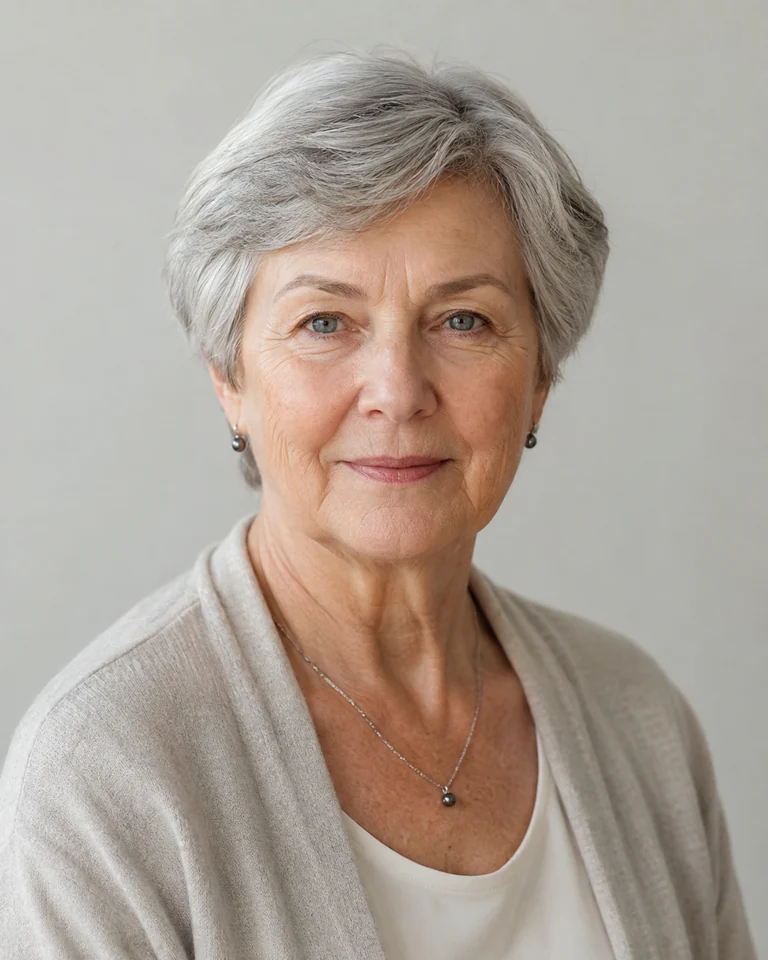
LIVING PROFILE
Nijolė Balsienė
Laboratory specialist
Nijolė Balsienė lives in Vilnius and has built her career around laboratory work, where patience and accuracy matter more than speed or visibility. She was drawn to science at school because experiments made abstract ideas tangible. A result could be observed, repeated, questioned and improved. That habit of careful o…
Gyvenimo istorija
Gyvenimo istorija
Nijolė Balsienė lives in Vilnius and has built her career around laboratory work, where patience and accuracy matter more than speed or visibility. She was drawn to science at school because experiments made abstract ideas tangible. A result could be observed, repeated, questioned and improved. That habit of careful observation stayed with her. Even outside the laboratory she tends to notice small differences: how a plant changes when moved to another window, why a recipe behaves differently with a new ingredient, or which detail in an old photograph reveals where it was taken.
Her professional life began with routine analytical tasks and gradually expanded into responsibility for more complex procedures, documentation and quality control. Nijolė learned that reliable laboratory work depends on discipline long before the moment a result appears. Samples must be handled correctly, equipment maintained, methods followed and anomalies recorded rather than ignored. She became the colleague people asked to review a confusing sequence or explain why a result did not fit expectations. Her answer was usually to return to the process step by step rather than search immediately for a dramatic explanation.
She has always enjoyed helping younger colleagues become confident. Her teaching style is calm and specific. Instead of saying that something should be done “carefully,” she explains which mistake is most likely, how it can be detected and what evidence should be kept. She believes professional standards become real only when people understand their purpose. A checklist can prevent an error, but understanding why the checklist exists helps a person recognize a new problem that is not written on the page.
Nijolė's relationship with Vilnius is tied to walking. She likes routes that cross different layers of the city: older streets, residential districts, parks and newer areas that have changed quickly. She often photographs details rather than landmarks—doors, signs, trees in courtyards, market stalls and the changing light on familiar buildings. Over the years these ordinary photographs have become a personal record of how the city and her own routines have evolved together.
Family archives are important to her because she knows how easily information can be separated from evidence. A photograph without names becomes difficult to interpret; a letter without a date loses part of its meaning. She has gradually organized family photographs by period and added short notes about people, places and relationships. When relatives disagree about a memory, she does not see it as a problem to eliminate. She prefers to record the different versions, because the differences themselves reveal how people experienced the same event.
At home she enjoys gardening on a small scale, reading biographies and preparing meals that connect different generations of the family. She keeps some recipes exactly as she learned them and changes others without hesitation. The distinction matters to her: tradition is worth preserving, but it should not become a rule that prevents adaptation. She applies the same principle to technology. She adopts tools when they make information clearer or easier to share, but avoids systems that add complexity without a practical benefit.
Nijolė values privacy and context. She is comfortable sharing parts of her story publicly when she understands why they are useful, while keeping family relationships and more personal information within trusted circles. She believes digital memory should be designed with the same care as scientific records: access should be intentional, changes should be traceable, and important material should not depend on a single device that can be lost or forgotten in a drawer.
Looking back, she sees her career less as a sequence of positions and more as years spent learning how to make observations trustworthy. That lesson influences how she thinks about personal history. Memories are not laboratory measurements, and she would never want them to be reduced to data points, but they also benefit from names, dates, voices and explanations. A good archive leaves room for emotion while still giving future readers enough structure to understand what they are seeing.
If younger relatives open her profile many years from now, Nijolė hopes they will find more than a formal biography. She would like them to see the city she walked through, the work habits she valued, the family stories she tried to label before they became anonymous, and the everyday curiosities that made her stop and look twice. To her, preserving those connections is a form of care: a way of making it easier for another person to continue a story without having to reconstruct everything from fragments.
Showcase note: this is a fictional Kinelio demonstration profile. The biography and personal details in this showcase record are synthetic and are used only to demonstrate the structure, privacy controls and public presentation of a complete living profile.